思云献给我亲爱的外公德宝
According to the Oxford Dictionary, ‘savor’ means ‘enjoy or appreciate (something pleasant) completely’, or ‘have a suggestion or trace of (something, especially something bad).’
When I was kayaking in my friend’s backyard in Sentosa, also known as the Beverley Hills of Singapore, my grandparents caught covid in Shanghai during a Covid surge. I returned on the 24th of December, was put in an isolated quarantine center for five days, and finally saw my grandpa in the hospital on the 29th of December, 2022. I wrote down many of my thoughts after he passed away. I was and still am afraid — if all I have left of him is memories, what do I have left of him when I forget?
My grandfather was really smart, adventurous, and selfless as a husband, dad, and brother. He was a traveler, a reader, a giver. I have 22 years of memories with him as my grandfather, but for some reason, most of my images of him are after he got sick. He got shingles with a level of pain enough for patients to commit suicide, lost his eyesight to glaucoma, and lost his mobility due to Parkinson’s. Then his memories started getting messed up, and sometimes refused to take medicine because he thought we were conspiring against him. He started calling for his mom, who passed away a few decades prior. I used to ignore his needs because of his confused state of mind. When I feel lonely trying to sleep at night, I think about how lonely he must have felt in a house full of people on his sleepless nights.
December 2022 was the first time I could see him in an entire year due to absurd local airline restrictions and covid policies. I brought many food-related gifts, hoping he could enjoy as much as possible with his limited senses. I made a red bowl for him so he could spot rice more efficiently with a red background, got him the organic fruit stripes I love from Decaf and hard to find in China, and his favorite candies in Qatar, where I had my layover. I also printed out a 3D photo of us, so he could touch a photo of us, although he couldn’t see it. When I was released from quarantine and finally saw him, he was unconscious and couldn’t swallow or talk. He lost all tools to enjoy life.
Looking back, I ignored his suffering when he needed me the most. During my Covid gap year in China, I saw indulgence as savoring life — to feel the most intense emotions I could and be ‘free’ as much as possible. So I went clubbing all the time, begged for romantic connections like a dog, left the house as much as I could, and turned a blind eye to his suffering. I remember one day when I was talking to him in his room. I said something mean, and he said he felt sad when his tears didn’t drop but stumbled to the ground. He couldn’t see that I saw he cried, and I pretended that I didn’t. Now I savor the pain of missing him and chew on my gut filled with regrets. I lost my chance for redemption.
Stop. Brene Brown, a researcher on shame and vulnerability, says people nowadays are fixated on scarcity in our lives: when we go to sleep, we think we haven’t worked enough during the day; when we wake up, we worry about not having gotten enough sleep. I wonder if I was also using the scarcity mindset with my grandpa, thinking about everything I did not do for him and everything he lost.
When I caught up with my first love in New York, I felt the same kind of pain: realizing what I used to cherish so much would never return. Us, feeling in love, my younger self. But here is the thing about memories — it leaves you an aftertaste and another one. You can’t compare these tastes that are derived at different times from one single bite that is already gone.
People always say you only learn to appreciate something after it is gone. It is true: we are stupid until hit in the head. When I dive into my memories with him, I realize his love has always been silent. Despite his growing sickness, he was always present at the most significant milestones of my life. He picked me up every day from kindergarten until he sent me away to boarding school in Costa Rica, then asked me to care for myself when he couldn’t do the same for himself.
In New York, for the first time in a long time, I thought of guilt-free memories with my grandpa. I remember he told me that getting angry is the stupidest thing one can do because anger is stored in your own body. I remember him teaching me how to bike, play badminton, and swim. I see his handwritten message on my childhood photo album, on my face with the eyebrow I got from him, and the kindness he had always showered me with.
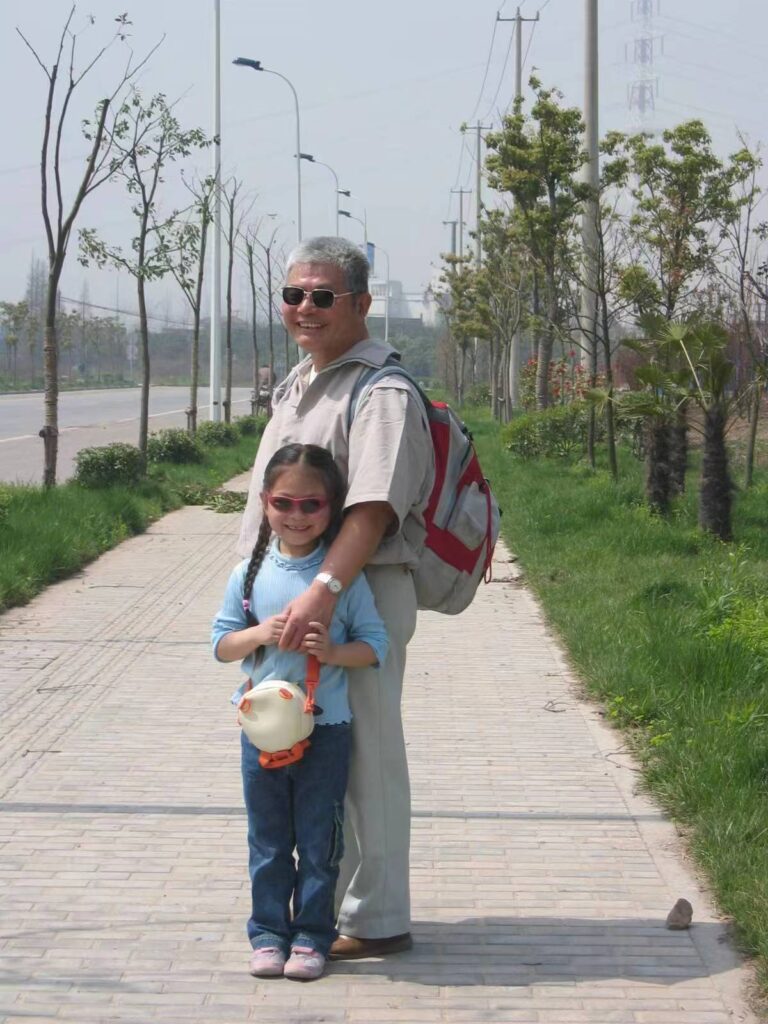
According to Émile Durkheim, a French Sociologist, dreams are visits paid by our loved ones because they want to see us and connect. I used to blame him for his stillness in dreams, but now I wonder: how precious is it that he is trying so hard to see me, despite feeling so unwell? Before, I couldn’t look beyond pain, regrets, and shame. But my grandpa’s life was not monochrome, and I don’t want to place our picture memories in a sealed black box. So here is the best part about putting someone on top of your heart: they know how to find you again and again, as if they never left.
About the author:
Selene is 22 years old, girl, Chinese, Japanese, alcohol-very-intolerent, ADHD…
She is a cultural sandwich with a heart as soft as firm tofu, and the three words she wants others to describe her with in life are: Genuine, Colorful, and Loving & Lovely (sorry but can’t find a word that combines both so here they serve as one word!).
