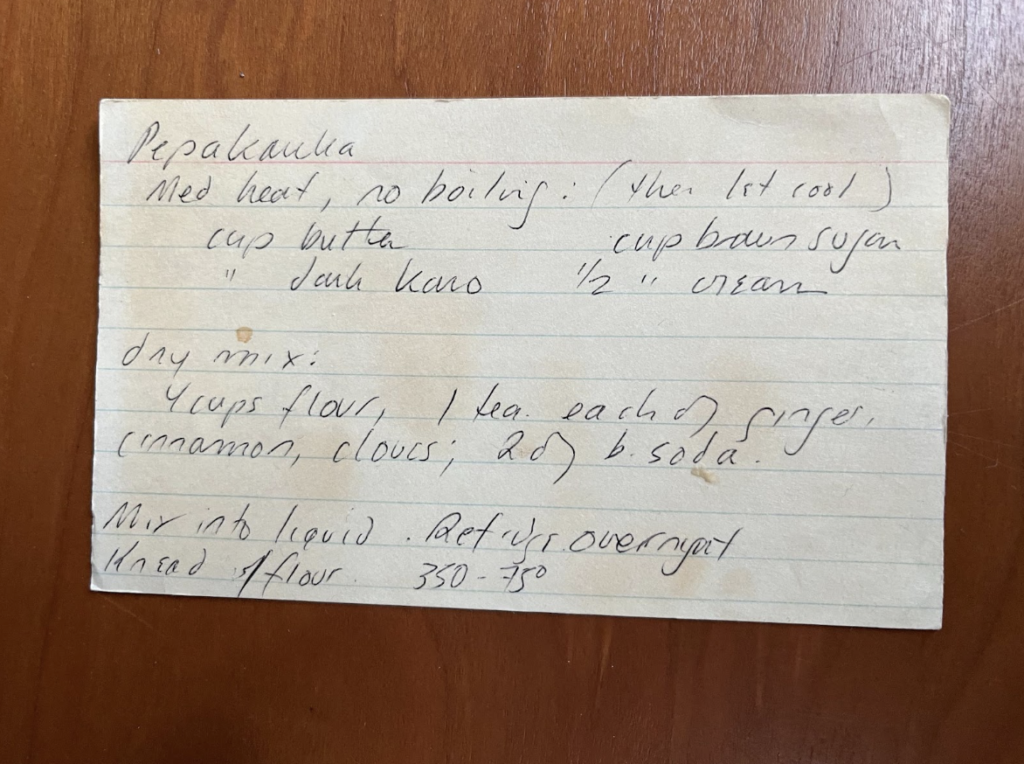
Gingerbread or gingersnap cookies are a staple of many households during Christmas time, and Swedish families are no different. A recipe for these holiday cookies has been passed down a couple generations, and now rests in a drawer, generally untouched, due to the fact that my mother has memorized the simple recipe. My mother’s side of the family is Swedish and both her name, Karin, and mine, Linnea, are Swedish names picked out by my Grandmother, Ruth. Cookies seem to be some matriarchal tradition – all of my grandmothers (all 4, my grandparents each remarried), included cookie making in the time we spent together before they passed. This recipe however, is the only one my mother and I continue to make together each year without fail. The multiple-day tradition is far different than the store-bought cookie batches my step-grandmother and I used to make, and the mundane baking process of sugar cookies I used to make with my other step-grandmother, that were designated more for decorating than eating.
Step one of Pepperkakor happens the night before the day you intend to bake the cookies. Per the hand-scribbled instructions, one must melt 1 cup of butter over medium heat and not allow it to boil. Let it cool, and add into a large bowl, along with a cup of brown sugar, a cup of dark karo, or molasses if you don’t have any, and ½ a cup of heavy cream. For the dry ingredients, you mix together 4 cups of flour (type not specified, we usually use regular all-purpose), 2 teaspoons of baking soda, and 1 teaspoon each of ginger, cinnamon, and cloves. Then combine with the liquid ingredients and mix it all together until smooth, and it should be a dark brown, thick gooey paste. Then cover the bowl with saran wrap and pop it in the freezer. Pepparkakor needs to be frozen at least overnight, because the dough is so gooey that attempting to roll it immediately would be a disaster.
The next day, once the dough has been frozen for a little while, it’s important to put out plenty of flour on the table before you attempt to roll it out. If the dough is rolled out too thick, the cookies won’t cook evenly, and if it is too thin, the cookies will come out too crispy. I couldn’t tell you exactly what thickness the cookies are meant to be, but it’s been enough years that I have developed the sense to tell exactly what size they are meant to be.
There is no myth or legend or family secrets mixed into the dough of Pepparkakor. In many respects I have no connection to my Swedish family. Those who are alive live in Sweden, and speak little to no English. There was a Swedish family reunion in Chicago in 2021, where my Grandmother grew up and where the rest of my mother’s family lives, but I had to attend school that summer so I didn’t meet my oversea relatives. Maybe I’ll get the chance in another 10 years or so. My mother speaks very little Swedish and other than recipes, trinkets, occasional emails from relatives and stories, she has little left that connects her to her heritage either. The only consistently Swedish thing I partake in is Pepparkakor, and I’m not even entirely sure how to pronounce it. All this usually doesn’t bother me, but every once in a while I mourn that my mothers heritage will die along with me because I haven’t absorbed much Swedish tradition.
Once the dough is rolled out to the correct thickness, the best part comes. A box of old and new and misshapen and meaningful and meaningless cookie cutters comes into the mix. I, as the youngest in the house and historically the only one who really cared, got to pick out which cookie cutters to use. My favorites were, and are, an L (for Linnea), a large bunny, and a boot. My mother would scold me if the cookie cutters weren’t close enough together, because re-rolling out the dough made it tougher each time.
Something I’ve gotten immensely irritated with, but also come to appreciate, is the fact that every year, without fail, my mother walks me through the process of making Pepparkakor as if we haven’t made it a million times before. She reminds me each year: “don’t ever forget to freeze the dough”, “be subtle with the spices”. I could remind her back every time that I basically know the recipe by heart now, but as much as it would satisfy her that I know the recipe, it would stop her from trying to ingrain it into me. The teaching, I’ve come to find over the years, is most of the reason why she enjoys it. This is partly why I think she hesitates to teach it to my brother, who she knows won’t bother to remember it next Christmas.
I don’t get the impression that my mother made Pepparkakor often with her mother. Maybe she did, but that’s not part of the narrative she creates around these cookies. For her they are always considered a tradition between the two of us, and at the same time, as someone who isn’t very into sweets, she happened to make one of the few kinds of cookies I like into a Swedish family tradition. Even though I only eat less than 10 of the dozens of cookies we make every year, I don’t shy away from joining her in making them each time. It is unspoken, or even unconsidered, that this will be the Swedish tradition I keep, along with a few wooden Dala horses.
Christmas of 2021, my boyfriend joined us in our ritual for the first time and helped me pick out the different shapes for the cookies. He suggested making frosting and I thought it might be good, so, apprehensively, my mother agreed even though it is not traditionally used for these cookies. Christmas of 2022, when my mother and I made Pepparkakor once again, and filled the house with the familiar ginger smell, she asked if I wanted to make frosting again, and I declined the offer, saying they taste better on their own. She smiled, and agreed.
About the author:
Linnea Colton is an Oberlin College student graduating this spring with a psychology degree, and with an interest in environmental systems. Her favorite format of pasta is linguini, homemade by her mother.
