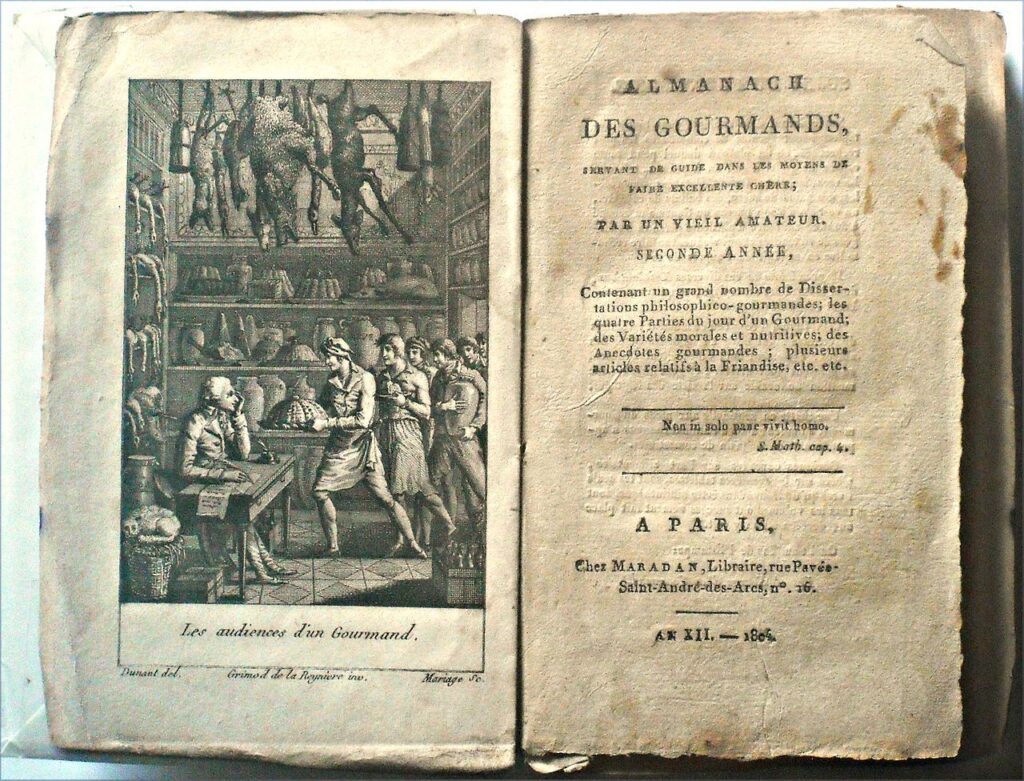
Photo of Grimond de la Reyniere’s Almanach Des Gourmands.
In his description and analysis of Grimond de la Reyniere’s rise to power in the world of French cuisine, Michael Garval reveals the origins of French food culture. Freed from their bonds to their aristocratic clientele, chefs in post-Revolution France had a newfound power to cook and serve whatever and whomever they pleased. Tastemakers like Grimond determined that the French public needed guidance in navigating this new world of cooking. Despite the social leveling that occurred after the French Revolution, people like Grimond de la Reyniere did not believe that lay-eaters had the power or knowledge to feed themselves, or to “recognize and praise culinary achievement” (Garval, 54). As they see it, the responsibility of the gastronome is to provide information and set trends in the world of cooking that the public is not capable of providing and setting themselves.
Since the culinary arts were for so long reserved for the aristocracy to enjoy, it follows that gastronomes would see the public as incapable of understanding and appreciating culinary skills. And to a certain degree, this is true. Diets ranged significantly based on social class in pre-revolution France, and so to expect lower-class people to appreciate the grandiose dining standards of the aristocracy is unreasonable. Still, there is something to be said about the universality of good food. While the customs associated with fine dining may not be something that lower-class people are familiar enough with to appreciate, it is not as if their taste buds are any less sensitive to the deliciousness of a well-prepared meal. The role of gastronome in the world of French cuisine assumes that people do not have a natural, inherent understanding of good food.
To be fair, Grimond specifically spent a fair amount of time listening to the public for the amount of time he spent pontificating to them. His most famous work, the Almanac, was heavily influenced by submissions (and even samples) sent in by the readers of his previous works. In this way, Grimond attempts to correct the false assumption that he is writing for some kind of newborn public without a clue what makes good food. Generally, though, Grimond’s high status in the world of French cooking before the revolution assures that he speaks from a position of power over his audience, and his work is not quite as egalitarian as Garval seems to believe.
The power of the gastronome relies as much on the assumption that the public needs direction as it does on a false sense of objectivity around good food. Not only is the public incapable of deciding what is good on their own, but what makes one kind of cooking better than another is a matter of fact. In telling people what and how to eat, Grimond asserts an objective standard of goodness. His general rule is that French and, more specifically, Parisian, equals good. Everything else is imperfect, waiting to be Frenchified, and perfected by wealthy, powerful, highly trained, male chefs working in Paris. He and other tastemakers of the time ignore the reality that there is no one right or good kind of cooking, and assert French superiority at every opportunity. In this way, Grimond and others served as political figures as well as tastemakers. Led by a strong sense of national pride and funded handsomely for their work, tastemakers saw and used the new world of French cooking as an opportunity to unite the public under a sense of French superiority. Wars were fought and won in the kitchens of post-revolution France by players like Grimond.
The role of gastronomes and the assumptions on which their power lies are, evidently, questionable. As a historian interested in French cooking, Garval’s awed description of Grimond de la Reyniere’s life and work is understandable but lacks some nuance. Although Grimond’s influence can’t be contested, I think it’s important to question how necessary his guidance was in the years post-revolution. It’s not as if lower-class French citizens would have frozen, unable to decide where and what to eat.
Without the influence of gastronomes, a vibrant and legitimate food culture led by lay-eaters and chefs would still have developed. Given more autonomy and freedom, what would the public have decided was good eating? I have a feeling that without the guidance of Grimond and others, French culinary culture would look a lot different than it does today. Led by a group of people who did not hold power before the Revolution, unlike Grimond, post-revolution culinary culture may not have borne such a resemblance to pre-revolution cooking. As a result, it might not have the pretentious reputation that most non-French people know (and love, or hate) it for.
Ruby Feurstein is a second year Oberlin student from rural Pennsylvania. Ruby loves growing, cooking, and eating food. She cooks lunch every Wednesday at Harkness cooperative, where she lives and dines.
