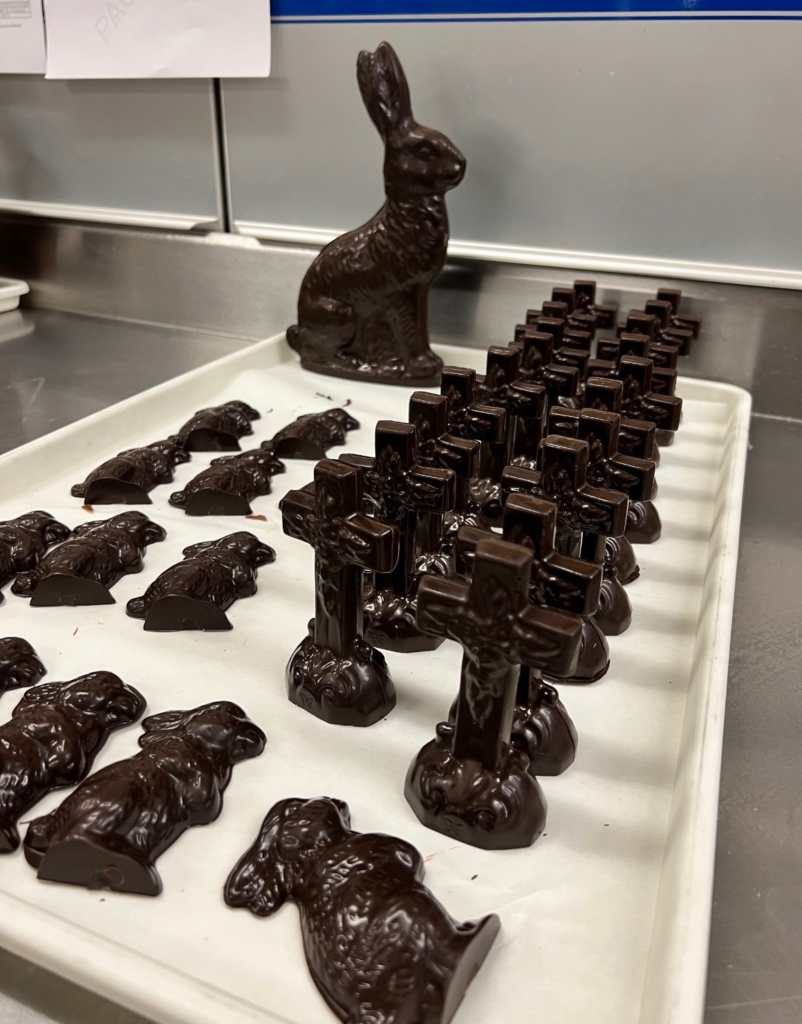
Mitchells chocolate bunnies.
Surrounded by chocolate bunnies, I couldn’t help but feel like I was 5 years old again. Jason Bean, one of the co-owners of Mitchell’s Chocolates, quickly ran through the history of the store noting that it was their 84th year in business–this made me feel even smaller. He gestured to the back wall where a giant black and white picture displayed an image of the original owners. Herded past the pristine glass cases filled with dolloped chocolates, my excitement heightened as we made our way to the back—we were entering Willy Wonka’s Factory.
Jason passed us off to Emily Bean, his wife and co-owner who enthusiastically welcomed us before jumping into a tour of the work area. There were giant mixers, big industrial conveyor belts, and huge vats of ooey-gooey chocolate. We watched as an employee took a small paring knife and whittled down one of their made-to-order chocolate bunny musicians–part of their chocolate bunny quartet where each bunny is equipped with their own little instrument. Emily showed us the molds they used for shaping, the grinders they used for crushing down nuts for pastes, and of course, she presented us with a tray of varied chocolates for each of us to taste.
As we tasted, Emily took us further through the history of Mitchell’s Chocolates:
Started in 1939 by Mr. Chris Mitchell, the store was originally located next to the Heights Arts Theater where it served as a neighboring concession stand for moviegoers. At the time, they only offered three types of treats–all of which are still sold today. However, once movie theaters began selling their own concessions, the Mitchell’s decided to switch tactics and turned to fine chocolates. The business, inherited by their son, Bill Mitchell, moved in the late 80s to Lee Road in Cleveland Heights where the store stands today. Emily and Jason Bean took ownership more recently in 2016. While the Beans are not related directly to the Mitchell family, Jason grew up in the surrounding area. He has fond memories of frequenting the chocolate shop as a kid where he knew Mrs. Mitchell would happily slip him a piece of chocolate.
While Jason’s personal ties to the shop make sense, I was more surprised to hear about Emily Bean’s trajectory into the chocolate industry. Originally trained as a Pharmacist, Emily partially-traded this med life to follow her love of making sweets into the chocolate business. I say partially because Emily, amazingly, still works at the University Hospitals of Cleveland two days a week. The other four days are spent on chocolate, and on Sunday she gets a much-deserved rest. A common thread shared by many restaurant-owners we spoke with this semester was the challenge of balancing work and personal life. Food service requires constant attention and care, which is difficult in a year-round business. Chocolate, while open year-round, follows a semi-different pace. The majority of Mitchell’s sales surround just four days out of the whole entire year: Valentines Day, Christmas, Mother’s Day, and Easter. We were visiting around the time of Easter and the rows of chocolate bunnies, eggs, and nests emphasized this rush. Something that also likely contributed to this intense chocolate demand was revealed when Emily pointed to the dozens of chocolate crosses made that day for a local church. They had received a last minute request, and she couldn’t say no. This highlighted a theme that seemed woven into Emily’s speech–the customers and community were at the heart of the store.
When we had first entered the store, Jason pointed out that Mitchell’s sold a special dark chocolate made with 58% cacao. This was specifically tailored to meet the dietary needs of the highly populated Jewish community present in Cleveland Heights, as their Kosher eating prevented them from eating the other milk products. This response to community needs was echoed in Emily’s story about the chocolate crosses and further emphasized by moments with specific customers whom she shared about. For instance, when asked who her top clients were, Emily shocked us by responding with a single name–Susie. Susie was a regular who loved to buy chocolates as gifts for her friends and family. So much so that after every purchase she asked them to ship an assortment of chocolates to her brother-in-law in Seattle, WA. He was a huge Mitchell’s fan and adored these care-packaged chocolates. He would often share this appreciation by sending hand-made thank you notes back to Emily and the store.
Next, she spoke about a customer who came in every year around Valentine’s Day. She remembers when he would come in himself, but now, in his 80s, he is usually accompanied by his son who pushes him in by wheelchair. He comes up to the counter and orders what he has ordered for the past 20 years, chocolate covered orange peels for his wife. They’re her favorite! Emily talked about watching as customers came in as young women, then pregnant mothers, and later holding newborn babies. She talked about catering weddings, holiday parties, and even funerals. Chocolate was a part of pivotal stages of celebration and remembrance, and she was able to be a part of these moments.
It was clear to me that the people who loved Mitchell’s were what made it so fun to work there. However, when asked specifically about her motivation, Emily’s answer was surprising. Her answer was automatic and certain–she did it to uphold the legacy. Tradition was so important that when their supplier discontinued their chocolate, she called them up. She worked out a special deal that made it so they could continue to get the type of chocolate they needed, one that customers had come to rely on. She also noted how when she first learned the recipes from Bill Mitchell, she had to hurriedly measure out ingredients and quantities. These recipes had never been written down before but rather passed down orally. They were made with measurements from the gut instead of numerical ones. She worked to ensure that she could recreate them exactly. While maintaining traditional recipes and ingredients was important, she also mentioned recent experiments with new flavors of chocolates. While we were talking she even tried to process leftover cacao nibs in a device she usually uses to ground up hazelnut paste. While this little experiment ended with the machine making an unexpectedly loud pop and no success, it proved something big to me: experimentation and tradition could work side-by-side and not just in opposition of each other.
At Oberlin, I am often surrounded by hyper-critical rhetoric when it comes to tradition which is likely what made our class so cautious in discussions of terroir. Terroir, while a complicated term to definitively define, is certainly grounded in tradition. Our class seemed fixated on how this term has been weaponized to defend old-fashioned methods and even used to deflect criticism of flawed systems in need of change. This tied tradition with more conservative systems and led to some reluctance in seeing the positives of terroir. While my mind was set on looking at tradition as something stuck in the past, Emily Bean worked by a different definition–a tradition that can be molded to the present. James Clifford provides an academic term describing the phenomena: tradition-as-process. This is “a vision of tradition as ever evolving, as continually being made and remade in a process that stretches from the past through the present and into future (John P. Murphy, 2018).” Emily Bean exemplifies this term in practice. She showed me that tradition and change, something I thought to be contradictory, could in fact be dialectical.
Mitchell’s Fine Chocolates, even after 84 years in business, has managed to stay relevant. They are able to keep the clientele who grew up with their store while also reaching newcomers. They maintain a level of tradition, while still upholding themselves to modern standards and changes. They are a business that has grown with their community and adapts to what they need. Their community loves their chocolate because Mitchell’s is able to return that love right back.
Works Cited
John P. Murphy (2018): Foie gras in the freezer: Picard Surgelés and the
branding of French culinary identity, Food and Foodways, DOI: 10.1080/07409710.2018.1454774
Brooke Levan is a second year student at Oberlin College studying as an Environmental Studies Major with a Food Studies Concentration and Studio Art minor. She enjoys all things food related–cooking for her student-run dining cooperative, growing foods in her backyard in San Diego, and finding fun eateries when she travels.
