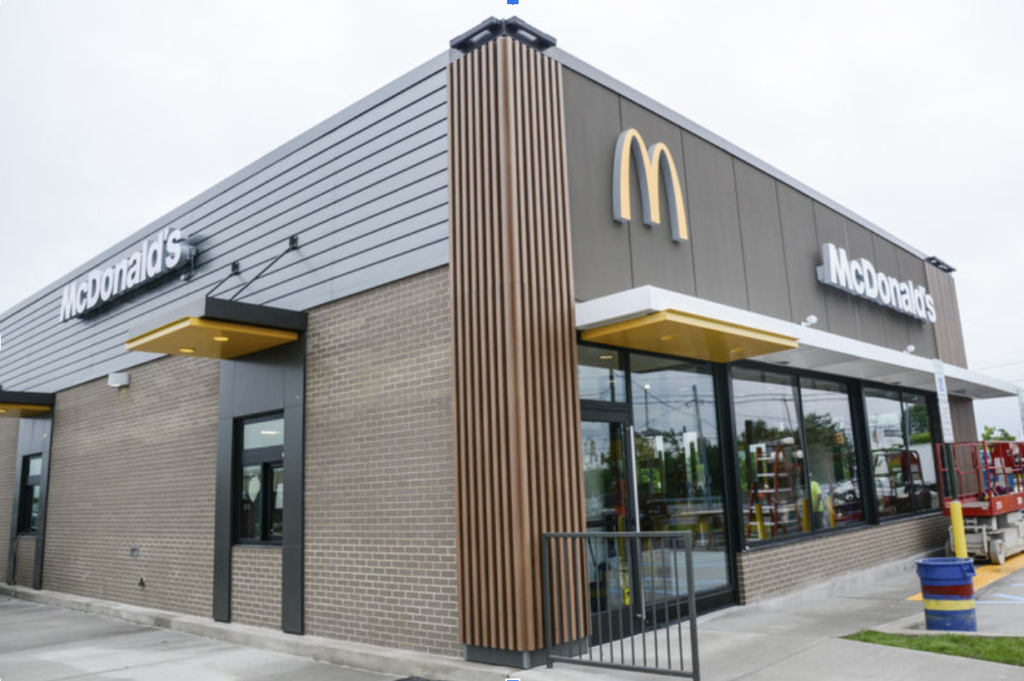
Exterior view of the McDonald’s restaurant in Lewisburg, Pennsylvania.
You’re seventeen (or eighteen, or fifteen) years old. Finally a junior (or senior or sophomore) in highschool and you’re looking for some extra cash. Don’t you want to flip burgers? Wear a visor? Come home smelling like a french fry? We know just by visiting a McDonald’s– seeing the register and grills staffed by teens– that many peoples’ answer to this question is yes. Afterall, who wouldn’t want the “best first job”?
Across the nation, McDonald’s is where highschoolers have their first job experiences: clocking in and clocking out, fighting with their coworkers, being yelled at by customers. I spoke to my good friend Maren about her personal experience working at McDonald’s during her senior year of highschool in order to get a better sense of what it was like, and to figure out if McDonald’s really is the “best first job.”
What I knew about her experience before conducting this interview was pretty slim. That Maren worked at McDonald’s was sort of a running joke within our friend group. We would text and ask if she was on drive thru or register, then rush over in somebody’s parent’s car and ask her about the drama at work that day. She would complain about coming home smelling like grease, and lament the uniform and visor she’d have to wear. We would joke about her similarity to our classmates who also worked there.
“Brandon was one of them, Harmony used to work there, Porter works there. All kinds of people. I don’t know how to describe them, obviously you know them, but. [Laughing] Yeah, um. [Laughing] Those kind of people work there.”
Needless to say, Brandon, Harmony, and Porter were not popular kids. But for all that we joked and all that she complained about, I knew that Maren didn’t ever truly hate the job. Her relationship to McDonald’s was more complicated than that.
This complexity came through in our interview, which she happily agreed to and which went on for much longer than I expected. I gave her a ring and after we had caught up on each other’s lives at school, I honed our focus. I first wanted to know the basics: who works at McDonald’s?
“[The] actual dynamic of a McDonald’s workplace– that is so fascinating. So there’s every type of person you’ve ever wanted to work at like any place. So you got fifteen year olds who, like [phone cuts out] and they’re the ones who are like literally on Xanax. Something like that. And then you have, 40 year old bisexual moms who have like three children, all of which go to different schools and have different fathers. And then, um, you have like, 50 year old women who are either managers or like, I don’t know they make minimum wage, it’s crazy. … Um, and then you have like the uneducated manager who is generally the 40 year old mom type, but they I don’t know they’re, like, normally chill, like very relaxed. And then you have the educated managers who, like, went to business school for some reason? … And then you have like the 50 year old men, who, like, have, at least at our McDonald’s, super harsh Pennsylvania accents, can hardly understand them at all.”
Maren seemed pretty confident in these stereotypes, and referenced them later in the interview as well. She also noted, in response to this question and a few others, the length of time some of her coworkers had been working. She says that the 50 year old women and men “… just work at McDonald’s and they’ve been doing that for like, 20 years.” There are hints of some potential power dynamics in her descriptions, like that some of the managers went to business school or that some people have been working there for so long, but it seems like everyone is pretty much equalized by the fact that they’re working at McDonald’s. That way Maren spoke about her relationships with her coworkers in our interview, both managers and long-time employees, seemed friendly and comfortable.
This isn’t to say that McDonald’s is free of hierarchies and prejudices. Maren made a point of identifying gender dynamics within the structure of the entry-level positions: grill and service.
“It was super gendered actually, which I found interesting. Like a lot of the customer service people were women, and a lot of the grill workers were men. And that wasn’t often flipped unless people has been there for a really long time and then they could go back and forth. But like, if you were a girl you started out on service and if you were a guy you started out on grill.”
I asked how these gender roles get enforced. Maren suggested an element of self-sorting into gender roles as well as some encouragement from management.
“So a different person [than normal] was interviewing me and she was the 40 year old mom type of manager, and she had assumed I was going to be on register. She looked at me and she said, I remember her being like, “Oh you’re going into service, right?” And I was like, “What other option is there, like managing? Like, what do you want me to do?” And she was like, “Oh no, like, between grill. Like, most of the guys go on grill.” And so she had, like, acknowledged that too. So I assumed, “Oh I don’t really want to hang out with Porter and Brandon, so I’m gonna go on service.”
In addition to gender dynamics within crew positions, class and education were at play in the McDonald’s. Maren mentioned education in that first description of the crew members– the older male managers who went to business school (in addition to Hamburger University, as I discovered later in the interview). She also brings up education when explaining the politics of our local McDonald’s.
“Well, I want to comment on that a little bit actually, cause, um, there’s, like, kind of a conservative vibe to the workers at McDonalds. I think it’s a lot of the times due to, like, a lack of education of a lot of the people that work there, which, I hate to call them out but, like, it’s probably true.”
Maren mentioned the political and educational makeup of the crew in order to explain another downside of working at McDonald’s in 2020: attitudes toward covid.
“So people just like, wouldn’t wear masks or would wear them below their mouths. So that was really weird going into that job and just like having kind of to accept that, because every other place that I had dealt with covid it had been like super— you know school was obviously canceled. Like that was super strict, and so just going to McDonald’s and everyone is just like, “fuck this this isn’t real, like, whatever” um was a really weird vibe.”
Covid guidelines have generally relaxed since Maren first started working at McDonald’s, but the differences in education level of the crew members continues to affect the work dynamic. Maren goes to Colorado College and will pick up a few shifts at the McDonald’s during breaks from school. I asked her if coming back home from a fancy liberal arts school changed the dynamics between her and her coworkers. She jumped to an answer.
“Yea I think– I really do think it does, in the summer when I was going— I was working a lot before my freshman year of college, all of my coworkers were saying like, “You don’t have to go to college you should just work here,” like, “You don’t need to— like, what are you even going for, like, what are you even doing?” And I do notice when I come back and they say, “Oh, what are you studying?” And I say [laughing], “Sociology and music.” They’re always like, “What the hell?” Like, those aren’t real things to study at all. Um, so it is like an awkward kind of a um, separating between us. Like, my coworkers and myself because of that.”
This uncomfortable separation between school and work, between Maren and her coworkers, came through later in the interview as well.
“What I didn’t love about it was, like I was saying before, it’s such a separation between, like, an academic world and a real life minimum wage job. And so there was a lot of like, not genuine pressure, but there was a lot of pressure that they tried to apply, like, for me to like not go to college or for me to like not care about school, which was really weird because it was like, obviously this is a part time job and I’m seventeen years old so like, why would you take 100 percent of my mental energy you know?”
So McDonald’s is not an entirely equalizing environment– gender, education, and class politics still play out in structures and interactions between the 15 year olds on Xanax and the 50 year old male managers. This made the workplace more difficult to navigate and more uncomfortable for Maren. But there are other, more practical difficulties to working at McDonald’s that have less to do with politics and identity than the realities of the fast-food industry and minimum-wage work.
“And there was just a few coworkers that, like— and I felt bad because you know there’s like a sixty year old woman who’s a bitch and you’re like, “I get why you’re a bitch but also could you not be that? Because it’s really hard to work with you, you know?” So that kind of stuff is hard, and just like managers and general scheduling stuff, um, I think which is like regular for every minimum wage job.”
When I asked more directly about the downsides to working at McDonald’s specifically, Maren recounted the worst part of the job.
“Yeah I should also say I completely forgot about one of the shittiest parts of working at McDonald’s which is the customers obviously. Old people— I learned to hate old people. I learned to, like, feel really badly for mothers with five children but also kind of hate them a little bit because I’m like, “why are you bringing your kids here?”. That kind of thing. Learned to hate buses of people, like if you don’t call ahead bro [laughing]. All of that stuff like, I have learned to just— I mean I think that’s just customer service working, but that’s the shittiest part is the customers, without a doubt that’s by far the shittiest part.”
But putting old, bitter customers aside as an inevitable downside to minimum wage work, I wanted to know what incentives there were to work at McDonald’s. Maren mentioned a few of the benefits to working at McDonald’s in response to a question I asked about how having her own stream of income changed her young adult life.
“Um, so much better, um [laughs]. I don’t know I personally preferred [having my own income] because my parents weren’t like, often handing out money. Um, but I really like managing my money and my time. That’s just something I feel like I’m decent at. And I also— it was very helpful, like, as a young adult I don’t actually have to worry about, like, bills or anything and so really I have total freedom over what I want to do with my money. And so I’m like, really grateful honestly that I had that job, for the freedom of the money and just to know how to work a job, for the future.”
When I asked more directly about what made McDonald’s a good job for a young person, Maren had a lot more to say.
“Good things, let’s see. Um, it was a really easy job, so like— [laughing] I didn’t really learn much, which could also be a negative, but it was something where I could just come in everyday and just know exactly what I had to do. And there was like, a little bit of challenges because, you know, we have to make it quick, or like, people would get shit wrong and then you’d have to fix it. So that’s kind of, like, a fun— you know it’s new everyday and it’s busy everyday, but not too difficult. Um, I also liked, generally, the people I worked with, there were a few people I couldn’t stand, but everyone else was pretty much fine. I liked the schedule about it. I like the flexible hours. I like the food alright for lunch breaks and stuff– that was fun.”
But by far, the best part of the job was the pay.
“The biggest part probably was that they paid 9.25 which was the highest paying job that I found at the time, and easiest. Yeah so that was the biggest deal was that it was just really high paying compared to other places.”
And this is what the pros and cons ultimately came down to. Yes there were gender and class dynamics, yes the customers were rude and demanding, yes some of your coworkers suck. But for 9.25 an hour, for Maren at least, it was worth it. The freedom of having her own money was worth all the downsides to working fast-food.
Nothing Maren said in our interview gave me the impression that she regretted working at McDonald’s, or wished she had chosen somewhere else. Like I mentioned earlier, she still goes back and picks up a few shifts when she’s home from school. She keeps up with our highschool classmates that she worked with on social media. So it might not have been the best first job, but it certainly was a good one.
Ruby Feurstein is a second year Oberlin student from rural Pennsylvania. Ruby loves growing, cooking, and eating food. She cooks lunch every Wednesday at Harkness cooperative, where she lives and dines.
