I sat down, as I did every weeknight during my semester in Paris, at the small, circular table-for-two by the window. The kitchen was long and compact, the walls pressing in on each other, and my host mom was busy preparing eggs. Since this was breakfast-for- dinner, wine replaced coffee as the beverage of choice. As she served them up onto two plates and brought them to our little corner, she told me that something interesting had happened to her that day at work and that she was curious to hear my thoughts about it. A Parisian high school art teacher, she asked me if I was aware of la laïcité, a law in France that, essentially, ensures separation of church and state. Specifically, this law prohibits conspicuous religious symbols in French schools, which has come to be controversial as it allows crosses on pendants, yet is much more restrictive when it comes to people who veil for religious reasons.
She launched into a story about a student who wore a headscarf to her class and how, upon reprimanding her and demanding that she take it off, she was not supported by the rest of the faculty. They claimed it was adjacent to a male student wearing a helmet – in other words, not a problematic type of head-covering – and that it was not necessary for her to remove it. My host mom was quite upset about this and, after recounting the full story, asked, “You agree with me, right? T’es d’accord avec moi? She shouldn’t have worn it in class?” I was stunned into silence. As a textbook people pleaser who still had two more months to share with this woman, yet whose political opinions now seemed to be at odds with hers, I didn’t know what to say, so I resolved to nod uncomfortably, hoping that this noncommittal agreement would end the conversation.
France has a long and complex relationship with the East. “Orientalism,” a term coined by Edward Saïd, describes this attitude towards the East by not only France, but rather the entire West, as one that separates its people into two distinct groups: “West” and “East,” “us” and “them.” This creates an unbalanced power dynamic in which the West views itself as superior. They imbue themselves with strength and the East with weakness, which is “as intrinsic to Orientalism as [it is] to any view that divides the world into large general divisions, entities that coexist in a state of tension produced by what is believed to be radical difference.” (See Note 1) For Saïd, the empirical reality is often the opposite, with similarities greatly outweighing differences. While initially used as a means to justify colonialism, Orientalism was also a tool wielded by the West in simultaneous efforts to destroy the elements of “Eastern culture” deemed unwanted or inferior, whilst also draw from and appropriate those considered “exotic” or otherwise desirable.
Turquerie was a term that came about in the 1990s to define the “artistic or literary composition [produced in Europe] whose theme or picturesque details are borrowed from Turkish culture and other oriental forms.”(See Note 2) Originally a French word, the French indeed have had a push-and-pull relationship to the allure of “l’oriental.” Turquerie, a branch of Orientalism, has seen rises and falls in acceptance since the 15th century, but became particularly popular in the late 17th and 18th centuries, during the Enlightenment period. Associated with luxury, sensuality, and aristocracy, imports from the Ottoman Empire “invoked the foreign to refashion the domestic.”(See Note 3) It was a way in which luxury, widely accepted amongst European elites, yet often condemned by certain Christian ideals, could be associated with culture, and thus become not only permissible, but aspirational. And indeed, these aspirations were not only contained to objects and decoration, but food and drink as well.
The visual appeal of Ottoman fabrics, jewels, furniture, and their sensual and lavish connotations made them extremely desirable in art, plays, clothing, and décor. Indeed, it is believed that the creation of the sofa at the end of the 17th century in France descended from an Ottoman piece of furniture. By the mid-18th century,
manufacturers gave names such as “lit à la turque”, “lit à la sultane”, and “lit en ottomane” to new sofas produced in France, equipped with features unofficially inspired by Ottoman designs. The purpose of this was to “enhance the appeal of their new products, which they sought to present as the accessories of a lifestyle of sophisticated ease.” (See Note 3) Not only does this demonstrate the continued connection in the minds of the French between turquerie and leisure, but it also shows the way in which the French have a history of taking that which originates in the East and reclaiming it as part of their own identity, a phenomenon we will soon see with coffee.
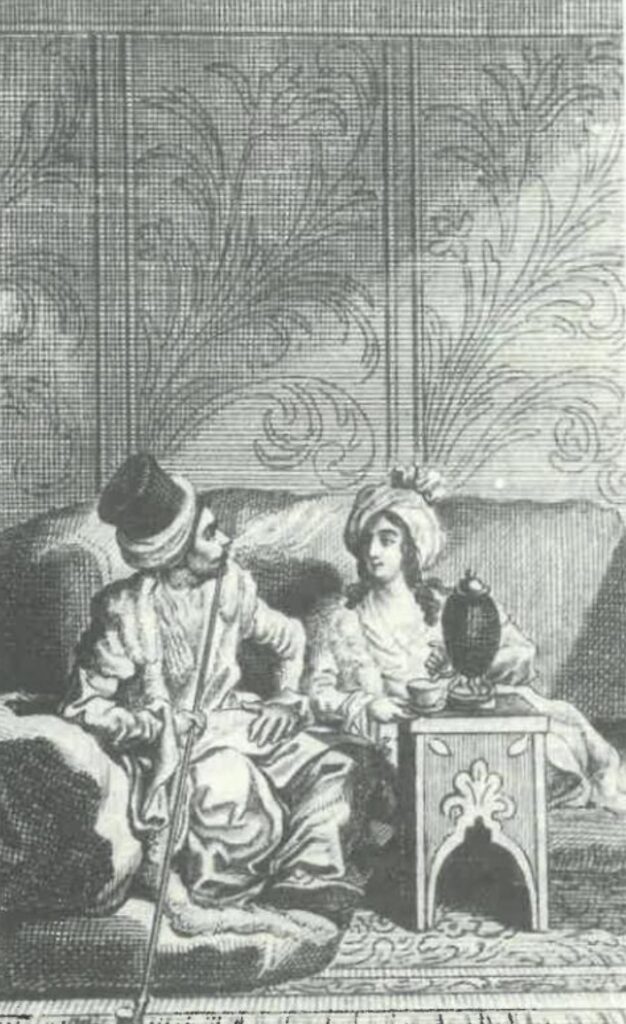
Drinking Coffee “À la turque” via Schivelbush
This Orientalist view was supported by the French fantasy of the East, which they imagined resembled a mythological place. The ideas and customs were so foreign and exotic that they resembled fiction or folktales, enabling the French to turn real people and places into their own illusions and creating a kind of lore around what they believed “Eastern” people should be like. In 1669, Suleiman Aga, the Turkish ambassador, paid a visit to King Louis XIV. The French royal court, excited at the prospect of meeting an “Oriental” and experiencing the grandeur they had heard about in person, put on a lavish display of wealth that catered to their expectations of the Orient. Much to their dissatisfaction, “not only did [Aga] not satisfy the curiosity of the Court as an Oriental ‘specimen,’ having appeared in a less elaborate costume than the Court had imagined, but he also seems to have been a lower rank officer with a bad ‘attitude.’” (See Note 4) Thus, it is evident that the Court did not view “Orientals” as people, but rather as screens upon which to project the idea of luxury, leading them to pursue new ways to represent this perception, one of which being in the image of “Orientals” as servants in a coffee context.
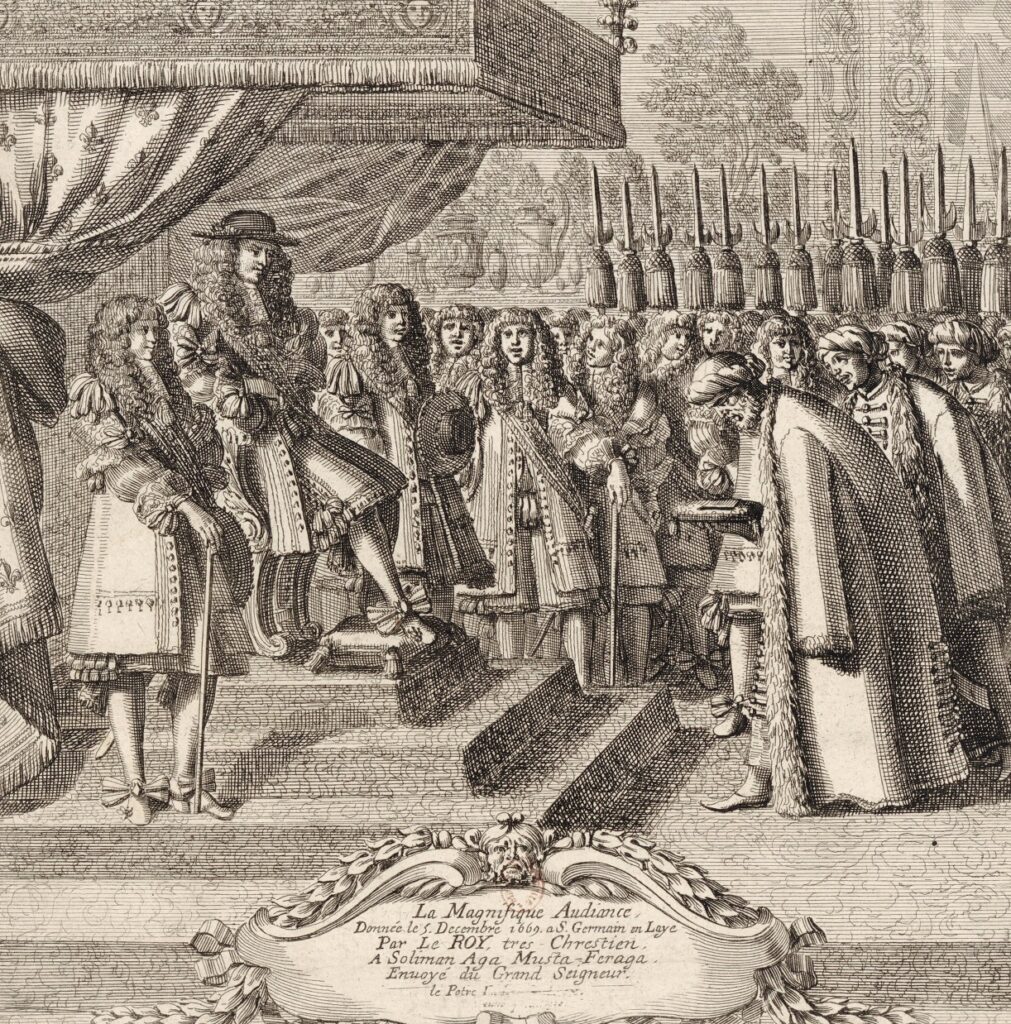
“La Magnifique Au-diance donnée le 5 décembre 1669 à S. Germain en Laye par le Roy très chrestien à Soliman Aga Musta-Feraga, envoyé du grand seigneur”
Gravure de Jean Lepautre / Jean Lenfant, 1669, Paris
via BNF
The theatricality of the Court’s reception of Suleiman inspired King Louis XIV to request a new play of Molière, one which more “accurately” depicted the type of Oriental exoticism that the French so desperately desired. This play, Le Bourgeois Gentilhomme, became incredibly popular, which was largely due to the scenes of turquerie that occur towards the end. The play follows Monsieur Jourdain, a recently wealthy tradesman, as he attempts to maneuver his way to becoming a “gentleman,” or a member of the upper class, frequently fooled by those he thought helpful along the way. By the fourth act, a denied suitor to M. Jourdain’s daughter disguises himself as Turkish royalty in order to gain her hand in marriage. (See Note 5)
Although not originally intended to be its central focus, it was the display of excessive Oriental grandeur expressed in the staging, costumes, and music that captivated audiences and emphasized their fixation on turquerie. However, Orientalism was not purely “positive;” underlying this obsession was fear of the “other,” fear that those aspects which the West did not feel were desirable from the East would play a part in Ottoman expansion, leaving the West less powerful than its Eastern foes. Indeed, the “Oriental masquerade in the play points to the desire to incorporate the Other in oneself and to attenuate the cultural differences by limiting them to the level of disguise.” (See Note 4) Similarly to their claim to the sofa, this allowed the French to reaffirm their own superior identities over the East, while taking those elements they deemed to be the “best.”
A new beverage emerged, subverting the idea that art and literature were the only forms of luxury affected by turquerie: coffee. Its first introduction to France in around 16406 was met with a dismissive reception due to the adverse associations with Islam and the Ottoman Empire at the time. However, by the late 17th century, a new wave of turquerie caused coffee to become a new fashion. It is interesting to note that in most studied aspects of Orientalism, there was very little discourse around Ottomans, and they were not often discussed in French literary works. When it came to coffee, however, it was associated “with the Ottomans alone” (See Note 7). This serves as a reminder that the West had the tendency to deliberately pick and choose which regions and customs in the East held the most appeal to them, while regarding the rest with disdain.
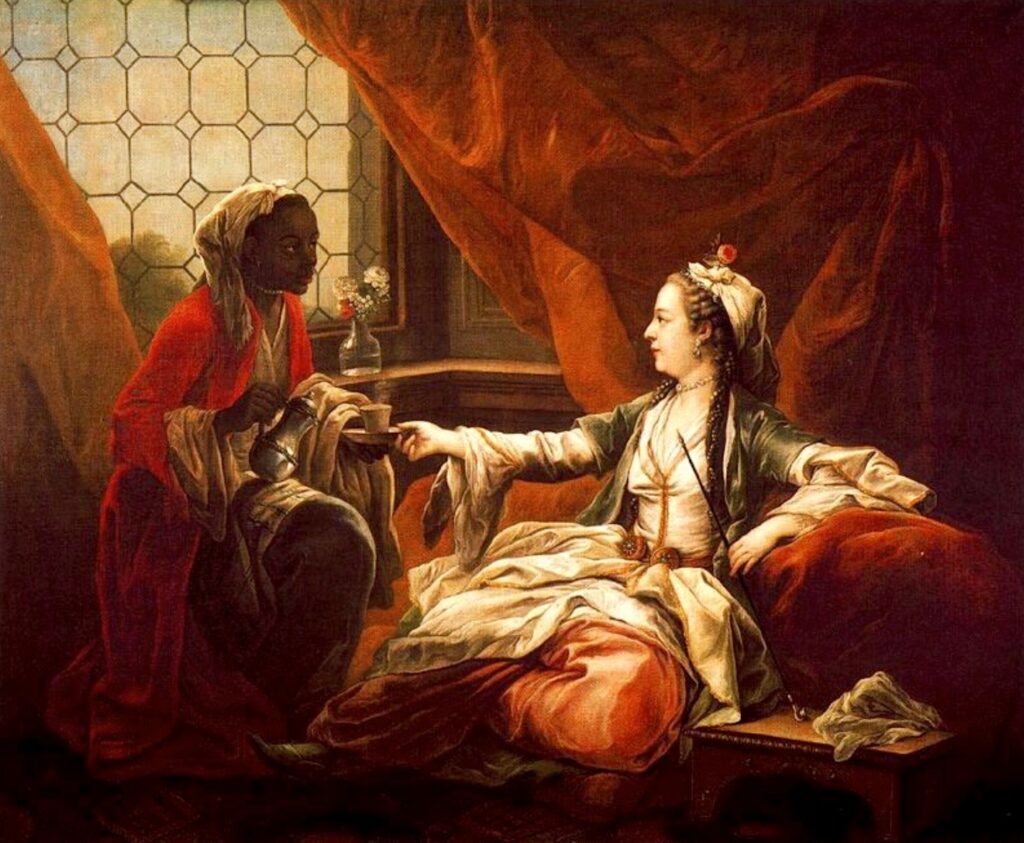
“Une sultane buvant du café” / “Sultan’s Wide Drinking Coffee” Carle Van Loo, 1752
via Bevilacqua
Initially a very expensive imported good, coffee was reserved for the elite. However, it wasn’t universally accepted. Although beginning to find a consumer base in the elite in the 1670’s, many French people were wary of this new drug and its possible negative effects, not to mention that, despite being viewed as “exotic” and “luxurious,” there were stillunfavorable ties to the Ottoman Empire. This dichotomy of thought amongst the French spurred public debate around coffee to move from exclusively academics to doctors, merchants, and pharmacologists.
The emerging research at the time, proclaiming the positive health benefits of coffee, intersected with the contemporary concept of “consumption clusters”, the combination of specific goods with one another that held social significance, thus increasing the consumption of certain, and often previously undesirable, products. The consumption cluster that gained popularity in France was that of coffee and milk. In the mid-1680’s, Philippe Sylvestre Dufour, a medically-trained Lyonnais spice merchant, publicized café au lait as a tonic, citing the many health benefits associated with it (See Note 8). French milk was a distinctly domestic product, one with significant regional importance, and the spread of this combination softened the previously held negative associations of coffee with Islam, Arabia, and the Ottoman Empire.
It also succeeded in adding a certain “Frenchness” to the drink, the beginning of France’s claim over the world of coffee. The spread of this consumption cluster and the resurgence of turquerie in the 1680’s created a fascination around the luxury of l’oriental, thus leading to not only the commodification of this good as French, but also leaving traces of the “exotic” that so widely appealed to the French elite population. As seen with the claim to the invention of the sofa and Molière’s Le Bourgeois Gentilhomme, there is a history in France of Eastern inspiration being pulled into the French identity in an effort to combat their fear of the “Other.”
The introduction of milk in the coffee-drinking ritual wasn’t the only way in which France took control of coffee. Up until the 18th century, the port of Mocha, Yemen, was the only place from which coffee was imported. Around 1716, after having successfully grown a coffee plant in Paris, thus making it a French plant, the French began to grow coffee on plantations in their colonies, most notably in Saint-Domingue, which would become the “world leader in coffee production” by the 1780’s. (See Note 7) While this may have been the start of France’s world domination of coffee, the French found themselves once again enthralled by turquerie in the 1740’s. The French, preferring to “turn a blind eye to slavery,” (See Note 7) capitalized upon this renewed fascination with the East and hid behind coffee’s Eastern origins, allowing it to once again gain popularity as an “Oriental” good rather than the result of slave labor in their own colonies.
Coffee’s initial rise in popularity cannot only be attributed to the beverage itself. The emergence of cafés, now a staple of Parisian society, helped to push public opinion in the direction of coffee while still upholding an Orientalist class divide. Before the 1680’s, coffee had slowly made its way to the long menus of pre-existing establishments. This addition did not cause any significant shift in the perception of coffee until coffee sellers started to open new establishments dedicated not only to coffee, but to improving upon the coffeehouse models of England, Germany, and the Netherlands. These French establishments primarily differed from the traditional coffeehouse in their interior designs, “elevating the luxury quotient … over the humbler English and Ottoman predecessors” (See Note 8) by adding “marble tables, large mirrors, and fancy chandeliers.” (See Note 8) In other words, making them “French” involved an appeal to aristocracy and a distinct turn away from the luxuries of the East.
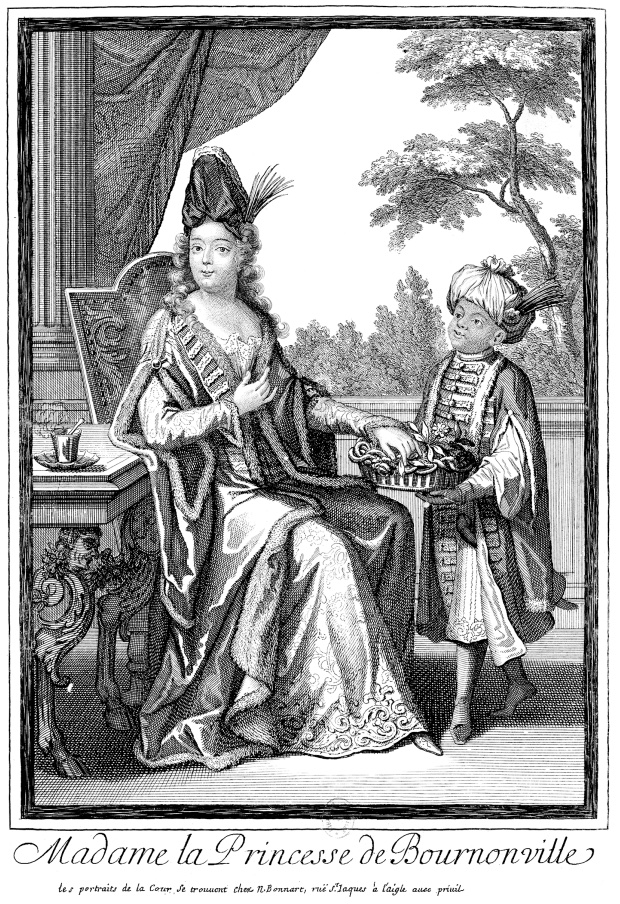
“Madame la Princesse de Bournonville, en pied” Nicolas Bonnart, 1694, Paris
via Landweber
However, despite appearing to have left the world of Orientalism and turquerie, these establishments did quite the opposite. In fact, they often “kept servers dressed like Armenians and Turks,” (See Note 8) keeping just enough turquerie to satisfy public taste while maintaining ties to French nobility and aristocracy. The choice to relegate the role of turquerie to a servers’ uniform, a position that inherently delegates power to patrons and takes it from those who fill this position, perfectly illustrates the French attitude towards the East. They wanted to both display France’s great wealth and sophistication and retain the fashionable presence of coffee’s forbears, but with the former being a representation of the upper-class and the latter being only a tiny portion of the dining experience, yet noticeably one that places the East in a position of inferiority. Even early coffee sellers followed a similar model, including “Armenians and Jews from the Ottoman and Persian Empires,” (See Note 8) which served to distinguish them from their French competitors. Thus, coffee itself can be seen as a catalyst for an even clearer presentation of Orientalism: the East serving a drink that had been taken from them to the thieves who claimed to be superior.
My first morning after arriving in Paris, I left my room utterly confused as to where I was. It seemed as though the previous day’s twelve hours of travel had left me exhausted and confused, and waking up in the apartment of the stranger with whom I would be living for the next 5 months did not help. Stepping into the petite cuisine, the bright light of the window illuminated the table at the far end of the kitchen, the sink, oven, and washing machine lining the right side and a bookshelf that served as a pantry on the left. Upon the table lay a brown paper bag, the top two corners twisted to preserve the freshness of the croissant and the pain au chocolat that resided within. To its right, a large red mug that I would come to discover was mine during those five months. Behind it, a tall clear French press filled about halfway with a thin, brown liquid.
From behind me my host mother approached and, almost startlingly, informed me that I could help myself to pastries and coffee. I undoubtedly needed the caffeine, but was wary – I am, unfortunately, very picky about my coffee. Fatigue, combined with a desire to be polite and partake in a breakfast ritual with my host mother, won the battle and I agreed to sit and try the coffee she had prepared for the morning. It was unspeakably bitter, lukewarm, and not at all the taste I had created when imagining French coffee back in the US. Although more closely resembling traditional Eastern coffee than the French café crème, this drink served as a doorway into her French identity which, as for many throughout French history, included bitter Islamophobia.
Bibliography
- 1. Said, Edward W. Orientalism, Random House, New York, 1979, p. 45.
- 2. “Turquerie.” Oxford Bibliographies,https://www.oxfordbibliographies.com/display/document/obo-9780199920105/obo-9780199920105-0165.xml.
- 3. Bevilacqua, A., and H. Pfeifer. “Turquerie: Culture in Motion, 1650-1750.” Past &Present, vol. 221, no. 1, 18 Oct. 2013, pp. 27, 29.,https://doi.org/10.1093/pastj/gtt019.
- 4. Behdad, Ali. “The Oriental(Ist) Encounter: The Politics of Turquerie in Molière.”L’Esprit Créateur, vol. 32, no. 3, 1992, pp. 37–38, 42.,https://doi.org/10.1353/esp.1992.0033.
- 5. “The Bourgeois Gentleman (Play) Plot & Characters.” StageAgent,https://stageagent.com/shows/play/19333/the-bourgeois-gentleman.
- 6. Khan, Iftikar A. “Coffee Trade of the Red Sea in 17th and 18th Century.” Proceedingsof the Indian History Congress, vol. 57, 1996, p. 308. JSTOR,http://www.jstor.org/stable/44133322.
- 7. McCabe, Ina Baghdiantz. Orientalism in Early Modern France Eurasian Trade,Exoticism, and the Ancien régime, Bloomsbury Publishing, London, 2008, pp. 166,214.
- 8. Landweber, Julia. “‘This Marvelous Bean’: Adopting Coffee into Old Regime FrenchCulture and Diet.” French Historical Studies, vol. 38, no. 2, 1 Apr. 2015, pp. 208, 209., https://doi.org/10.1215/00161071-2842542.
About the author:
Lila Victor is a graduating 3rd year majoring in French and minoring in Creative Writing. She is from LA, a pianist, and enjoys trying new recipes, perfecting old ones (for both baking and cooking), and working on her latté art.
