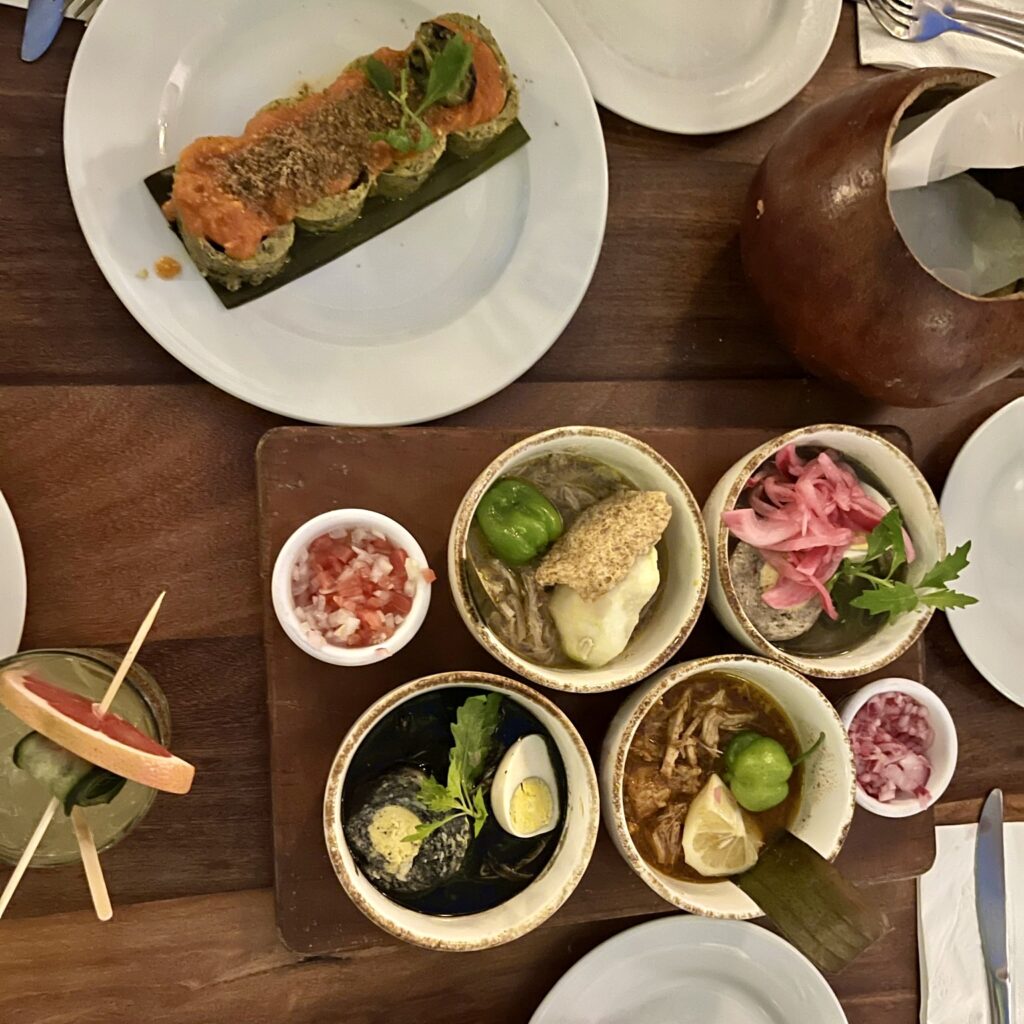
This table displays the food that my friends and I had on our first night in Merida at Museo de la Gastronomía Yucateca. I wasn’t too fond of the appetizer, a sliced tamal dish described below. Next to this dish is a platter containing four Yucatecan dishes and a cocktail with a grapefruit garnish.
At Oberlin, students have the opportunity to pursue their interests outside of regular coursework during January. During my final winter term, I traveled to Merida in Mexico’s Yucatan peninsula to take immersive Spanish courses. Outside of the classroom, I enjoyed delicious food as it is the gastronomic capital of Mexico. I explored both queer/feminist spaces and local working-class spaces. As someone with an academic attitude and a passion for queer politics, I was curious about how my identity affected my interactions with these spaces. I wondered why I chose to visit certain places that my classmates did not, and how my queer identity impacted the way I bridged other differences. Restaurants can create third spaces that foster a sense of community. Overall, I believe that exploring these spaces allowed me to have a unique tourist experience that was shaped by my background as a student at Oberlin. Ultimately, everyone’s travel choices are influenced by what they have learned.
Museo de la Gastronomía Yucateca
During my trip to Merida, my companions and I visited Museo de la Gastronomía Yucateca, a charming and affordable restaurant located conveniently near our hostel. The establishment serves authentic Yucatecan cuisine, which is deeply rooted in the region’s indigenous Mayan culture. What sets this restaurant apart from others in the area, however, is the museum section attached to the front of the dining area, where visitors can learn about the history and significance of various ingredients and dishes that have been prepared by the Mayans for centuries.
The overall dining experience at Museo de la Gastronomía Yucateca was simply beautiful. As with many restaurants in Merida, the building was designed with an open-air concept, allowing patrons to dine under the open sky while surrounded by lush plant life. The building itself was originally a colonial-era home of a wealthy henequen (a fiber made from the leaves of agave, usually used in rope or twine, which is largely responsible for the wealth of Yucatan) baron, which added to the overall charm and elegance of the establishment. The atmosphere was refined, yet natural and inviting, with subdued lighting and intricately patterned floors. The space felt open and thoughtfully designed, creating a welcoming ambiance for diners.
After a long day of travel by bus and ferry, we were very hungry. As an appetizer, we ordered brazo de reina, a sliced corn tamal stuffed with hard-boiled eggs and pumpkin seeds, topped with a Yucatecan tomato sauce. We then ordered a few different Yucatecan dishes to share, including cochinita pibil, relleno negro, and queso relleno. Cochinita pibil, one of the most popular foods in Merida, is a slow-roasted pork dish that’s made extremely tender by the long cooking time and citrus acidity. The preparation of Cochinita pibil traditionally involved roasting a whole suckling piglet wrapped in banana leaves in an underground oven called a pib. It is marinated with bitter orange juices and achiote seeds, which give it its orange-red color. While knowing the meaning of cochinita may upset more sensitive travelers, rest assured that many modern restaurants use pork loin or shoulder instead.
As we walked through the museum section of the restaurant, it was evident that the owners take great care in preserving and honoring the history of the ingredients and dishes that they prepare. The signage and explanations were provided in both Spanish and English, and they detailed the traditional cooking processes used by the Yucatecan people. This added an educational component to the dining experience, allowing us to gain a deeper understanding and appreciation for the cuisine we were enjoying. I learned here that knowing the ingredients and where they come from makes the food taste better and makes one feel connected to something larger than just one meal.
Our identity as Oberlin students impacted where we chose to eat and the way we viewed our experiences. Our academic attitude provided us with an interest in the food and the history behind it, and our desire to learn Spanish made me more attracted to the Museo and other local restaurants. While some restaurants excel in creating a culturally immersive experience, others, unfortunately, miss the mark. For instance, La Chaya Maya is another restaurant selling Yucatecan food, but their approach to attracting customers made me feel uneasy. The woman making tortillas in the window seemed like a spectacle. As students attending a school like Oberlin, we tend to be more critical than typical tourists. While this feels elitist to say, it is because our campus environment places great emphasis on handling culture and appropriation with care. Although we are not perfect, we strive to think about these issues more than the average person.
Throughout our trip, I felt that we jumped at opportunities for experiences that others might feel hesitant toward. We were among the youngest students in our Spanish classes, while most of our classmates were middle-aged, affluent Americans. We talked about our daily activities and habits, and it was interesting to see how different our lifestyles were. While many Oberlin students are fortunate enough to come from financial privilege, our classmates in Merida were of an economic class that seems unattainable to the common Midwesterner. They frequently made casual mention of knowing celebrities or having retired early to travel full-time, concepts which seemed entirely unrealistic to my friends and me. One of the biggest differences was transportation—they relied on vehicles much more than we did, but we walked and bussed almost everywhere. The Museo was one of the only restaurants we had mutually visited, as we could hardly afford to visit any high-class dining establishments on our budget, versus our classmates, who went out to eat at fancy restaurants nightly.
San Judas La Cocina Economica
Our Spanish instructors, most of whom grew up and live in Merida, were especially valuable for recommending local eateries that aren’t as well-known to tourists. This is how we ended up at San Judas La Cocina Economica, a casual place serving one or two dishes at a time for workers on their lunch breaks. We stopped here in the afternoon after going to an art museum. I had a dish called carne roja, which consisted of beef with red-colored seasoning, refried black beans, and rice with vegetables, along with lettuce, tomato, avocado, onions, and a lime wedge.
During our visit to San Judas, it seemed as though we were the only tourists in the restaurant, and we made many interesting connections there. We ran into a salsa instructor we had met the night before in the square as well as a friendly local couple who invited us to meet them and their family for dinner at a local restaurant in the suburbs they had been eating at for decades. While food may be seen as mere sustenance from a non-academic perspective, food can actually provide a unique cultural experience that engages the senses. One’s somatic experience is unavoidably affected by identity and perspective. This influences the experience of savoring, both in taste and in thought.
El Apapacho
Another restaurant serving delicious Yucatecan home-style food is El Apapacho, a cafe and feminist bookstore. My friend’s Spanish teacher who grew up in Merida also recommended this restaurant to us. The fact that the restaurant is housed in a feminist bookstore impacted the relationship I had with the space. Our research online led us to choose El Apapacho, not just for the authentic Yucatecan food, but also because of our interest in feminist issues. I know that the staff also care about and are interested in feminist issues. This connects the business with my interests and gives an impression about the people who are running the cafe. I also just appreciate the aesthetic of books.
Similarly to the display at Museo, there was an effect of the atmosphere at El Apapacho. It was impacted by the values portrayed in the books, murals, and feminist politics. Despite not being related to the food, these values connected me with the people who were making it. The outdoor space was also decorated with colorful eclectic chairs, artwork, and plants. The restaurant also hosts visiting feminist workshops and film screenings.
Even the menu items at El Apapacho convey a message, as seen with the “Limonada Clitoria” drink I ordered. It shows their willingness to discuss topics that may be considered inappropriate in other parts of the world. Despite being in a Catholic country, El Apapacho takes risks. While some patrons did not seem to share our vibe, such as older, straight couples, my queer friends and I felt welcomed in a subtle way. El Apapacho is a feminist cafe that may not be explicitly queer, but it still made us feel at home. Being queer brought us closer to the Yucatecan cuisine served at the restaurant. However, I wonder if some customers would be turned off by a queer label.
This trip was a mix of getting out of our comfort zone while also seeking out areas we knew would feel welcoming and familiar in a way. Of course, four Oberlin students with leftist attitudes would flock to the nearest feminist bookstore-slash-cafe. I think without an Oberlin education, I would engage differently with the city culture and local food.
Mercado de Santa Ana
On a Thursday morning, my Spanish class was canceled while my friends’ class was still in session, which gave me some free time. I decided to explore the city on my own and visit a street market that I had on my list. Before my trip, I researched online and made a long list of restaurants to try. I wanted to try the food stalls at Mercado de Santa Ana, where I used my newly acquired basic Spanish skills to order for myself for the first time. The street market had an indoor area where people sold fruits, vegetables, and other foods, but it was also known for its delicious and affordable authentic dishes. I ordered a refreshing mango agua fresca and cochinita pibil panuchos: fried tortillas stuffed with refried black beans, then topped with pork, red onions, tomato, and avocado. I sat down at a table next to the park and listened to the man on the bench across from me softly playing guitar.
Later, I was sitting in another park near our school when a man approached me and we got into a conversation. He seemed like an academic, holding a book about systemic racism, and was eager to talk to me about privilege and neocolonialism. With my mullet and tattoos, I appear (accurately) as an American college student eager to talk about issues like this. He told me about his experience raising his family in Merida. He shared with me how local people were being displaced by Europeans and Expats who were moving to the city. He mentioned Ki’ Xocolatl, a nearby chocolate restaurant that advertises its authentic Mayan hot chocolate. My friends and I had been there the other day when we had a sweet tooth and were eager to sample the different spices that were used, considering that chocolate originates from Mexico. He explained that it was owned by a couple from Belgium. I felt frustrated and embarrassed for supporting a business that profited off the Mayan name while the owners were rich European people moving to this city and using the local indigenous culture to profit off of wealthy tourists. It is important that people feel connected to the food and traditions of the area, but it shouldn’t be at the expense of the local community.
Dix
Dix is a one-of-a-kind place that we visited a few times. We were drawn in by the fact that it was a gay bar. We knew we would be among people who were similar to me in some ways, not just in queerness but also in seeing the world differently. When we walked in, we were greeted by a neon sign that read “Welcome to Hell,” which could be seen as anti-Catholic in a conservative country. Their marketing was dark, neon, and fiery, but we were excited to be there. We knew we would be out of our comfort zone a little bit but we wanted that. Sharing an experience of a drag show with a bunch of strangers is a foundational experience of the queer community. The drag show was the highlight of our visits as it brought the most energy to the atmosphere. I always ordered the chicken tenders, which were consistently delicious. I assumed they were made from scratch in the small kitchen by the guy working the fryer.
Although it likely attracted many tourists, the space we visited had a lot of Mexican visitors and few foreigners. It was difficult to determine how many people were regulars. We chose to visit a gay bar because we all have some level of interest in the queer community. In queer spaces, we feel a sense of unity due to shared identities and values, even without exchanging words. Queerness in this environment allowed us to bridge our other differences. Though we were minorities in the space we felt seen in many aspects of ourselves.
Cadadía Bar Café
Cadadía Bar Café proudly declares itself on Facebook as “the feminist-run queer bar cafe you’ve always dreamed of.” Located in a once-abandoned industrial neighborhood, the bar features tall ceilings, open doors, and fabric-draped walls that give off a pirate ship-like vibe. While the warm candlelit atmosphere was inviting, what drew us in was their identity as a lesbian bar, as we had never been to such a space before. The tables were arranged in a way that provided couples seated by the window with a romantic and private experience. We ordered a charcuterie board and cocktails, which came with pretty dried garnishes and had a fun and spicy kick. I felt connected to the people around me, as most of them were women on dates with women. A local singer-songwriter performed some familiar songs such as “Ironic” by Alanis Morrissette and some songs in Spanish that I didn’t know. Although we had to walk for 30 minutes through a less-traveled area of town, we considered returning for a second visit based on our values and experiences with the business. We stopped at a convenience store on our way back to our hostel to buy some tequila. The two women working at the store warned us not to walk down the street, gesturing toward the way we came from. They warned us that it was a dangerous area with “prostitution”.
Marquesita Carts
Late-night sweet treats were crucial on this trip. I ate my share of ice cream and churros and I also had the pleasure of discovering the famous Yucatán street food known as marquesitas. These delectable treats can be found on the streets and in parks of Merida, sold from carts that are towed by motorcycles. They consist of crispy crepes that can be filled with any topping you desire.
Alexis, the social coordinator at our hostel, recommended trying them with Nutella and shredded cheese. We spent a lot of time with Alexis since he was the social coordinator of the hostel and his job was to ensure everyone had a good time. As a queer couple, my partner and I felt particularly comfortable around him because he liked to talk about his long-term boyfriend.
During one of our marquesitas outings, we discovered that the motorcycle carts selling them were actually illegal. This realization came about when we were in the middle of ordering and a police car suddenly appeared down the street. All the workers quickly packed up and rushed down the street to avoid getting caught. The woman working the cart quickly explained to us, in Spanish, that they would go around the block to avoid the police and we could meet them there to get our food.
During my time in Merida, I drew from my educational background at Oberlin to guide my experiences. We strove to avoid any unethical business practices and prioritized learning about the local culture. However, our approach to travel is not necessarily superior to others. I ventured into both queer feminist spaces and local working-class spaces to see how my academic and queer political interests affected my interactions. I found that restaurants can create third spaces that foster a sense of community, especially for those with specific identities. Overall, my exploration of these spaces provided me with a unique tourist experience.
This Feature Story was written by Athena Greaves, an Oberlin College 4th Year.
