Rugelach is a pastry embroiled in Jewish culture. Visually, it resembles a mini croissant; it can contain fillings ranging from Nutella to raisins to jam to chocolate chips, which are enveloped in a cream cheese dough. It has roots in kifli from Hungary, kipfel from Austria, and rogal from Poland.
For special occasions, such as the High Holy Days, my mother and I often make rugelach together using her grandmother’s recipe — or, at least, the parts of it that have survived. My mother’s grandmother, Anne, from whom my Hebrew name (Hana) comes, died in 1986 and, with her passing, her rugelach-making craft was lost, too.
I associate rugelach with large, extended family gatherings on major holidays and celebrations; with making five different batches to accommodate different preferences; with a surprise package in the mail from my mother who “made too much” and thought she would send some for me to share with friends. It is difficult to savor because rugelach is best when consumed in one bite so that the flavors can combine — from the center outward: a single chocolate chip; a thin, caramelized layer of apricot jam; a layer of savory dough; a cinnamon and sugar dusting on top that has been slightly brûléed in the oven. It’s best when shared and prepared with others, family and friends, alike.
I interviewed my mother about her own experience with rugelach, which involves savoring, ritual, and attempting to continue this ritual savoring in her grandmother’s absence. I conducted this interview in the hopes that learning more about the ritual of rugelach and what it means to my mother might help me to savor the pastry in a more informed and whole way in the future.
NB: My dialogue is in bold and signified by my initials, “AS.”
AS: Can you describe what the rugelach tasted like when your grandmother made it?
Cara Stevens: So, my grandmother’s rugelach was a tiny, intense, tightly-wound pastry spiral. You couldn’t taste any individual flavor. The texture was flaky. There was definitely an element of cinnamon and you could sort of taste the burst of sweetness of the white raisins in it.
They were bite-sized. You’d pop it in your mouth. There would be the flake of the crust, the initial taste of cinnamon and sugar, the pop of a white raisin, and sort of a satisfying finish because it was a heavy, dense, one-bite pastry.
AS: And when did she make it? Was it on the High Holy Days or just whenever?
CS: My recollection is she would make them often — not too often, they were always a special treat. But my memory is that she would come to our house and ring the doorbell, even though she had a key, and whoever opened the door, she would be holding a rugelach and she would pop it into their mouth with this great big smile, and that was how she entered the house.
So, it not only had the memory of the taste and the texture of the food, but also that connection of her knowing that we loved that it was an act of love and that we loved connecting to her in that moment when she would walk in the door.
AS: I’m wondering if you could eat another piece of rugelach and have that popped into your mouth again, would you do anything differently or appreciate it more?
CS: Let’s see. I was a senior in high school when she died. She had broken her arm and so she couldn’t make the rugelach by herself, but she was making it. And it was spring and she asked me to come over and help her. And I was nervous about driving there. I was worried about getting lost, so I didn’t go. And then she made them herself and brought them over. And it wasn’t long after that that she died. And so that was a big regret.
But the interesting part about savoring it is when she made them for the last time, we had had a family dinner where she came over for a Friday night. And we put the leftover rugelach in a tin — the blue tin from those Dutch cookies that you like — and put them in the spare freezer. And we had forgotten about it. So this is 1986. So years later, many years later, after you were born, when my parents were moving out of the house, we found it.
I think I regret not saving it even longer because we could have taken a picture of it for when we’re trying to recreate it from our sensory memories — but you can’t. You can’t capture it. Even eating it defrosted, 15 years later.
AS: When you make it now, is it a different experience? And if so, what makes it different?
CS: That’s a great question. Eating it as a child was very authentic and in the moment. The joy was the connection with my grandmother, but mostly it was just that childlike joy of knowing something is special and made just for you. And also knowing that it’s everyone’s favorite too. And recreating it now, it’s more about the joy of passing it along, of giving. It’s a deep emotional connection to the past and the future. But it’s not as much of a feeling of being in the present.
AS: What aspects of it connect you now to the past? Is it the smell when it’s cooking in the oven or is it the first bite or everyone coming together to eat it — or all of the above?
CS: It’s other people taking a bite of it. Handing it to somebody, popping it sometimes into their face or just putting it in their hands so they could taste it brings back that connection and makes me feel like I am the continuous person that I was when I was a kid and I was on the receiving end.
AS: And when do you make it now?
CS: Special occasions. I remember Noah was having a hard time in school, so I made a batch and mailed it to him. I know there are times when you need it, so I make it —
AS: And you ship it to me.
CS: And I ship it to you. During the pandemic, I made a lot of batches and sent them out to family to feel more connected. And when I’m with Dana or with you when we have some spare time. And each time we make it, it’s a little bit different because I feel like I’m always trying to recreate something that’s ultimately unattainable.
AS: What’s your favorite filling to put in rugelach?
CS: I would have to say the original, the apricot jam and white raisins. Ooh — with ground-up walnut and cinnamon and sugar. Sometimes I customize it for different people. Like I know Uncle Jay will only eat it if there’s no nuts and chocolate.
Oh — and there was one thing I wanted to tell you about the recipe. The reason that it’s so hard to recreate is because it was written on a fading index card that we inherited when she died. And it was one “glass” of flour, butter, cream cheese — it had no measurements. The index card was just a reminder for her.
AS: So, she just did it by heart, but she thought she might as well write it down.
CS: Yeah. And by feel. I’d love to know your experience of it and what your favorite filling is.
AS: I love that every bite and every piece is different. I especially like when it’s filled with Nutella or Nutella and strawberry jam, it adds sweetness to contrast with the somewhat salty dough. And I like it best when you can have it in one bite and when it’s at the end of a long meal and you feel like you can’t eat anymore, but it just smells so good and it’s been baking in the oven all day and you’ve been looking forward to that one bite of Nutella strawberry jam rugelach and you’re like, “I have to have it.” And everyone that you make it for is just so thrilled that you put that care into it.
—
My mother’s story reminded me of Proust, chasing the nostalgic joy of his first bite into the madeleine dipped in tea. Proust’s mother had served him the madeleine as an act of care, to provide him warmth on a cold day, and he was filled with “all-powerful joy.” When he attempts to recreate the experience years later, though, such joy does not persist past the first bite.
In her grandmother’s absence, the rugelach lacks its once-all-powerful effect for my mother.
After conducting this interview, I find myself reflecting on times I’ve eaten rugelach in the past. In particular, my mom and I made several batches during the pandemic to remind us of times spent with the extended family. It tasted different — eating it with just our family of four, grabbing handfuls from a cookie jar, rather than laid out on doilies and a china plate, as we did on the High Holy Days with our large extended family.
It was also harder to savor rugelach in this way; we instinctively made a batch as large as we would if we were bringing it to such a function and had to consume all that we did not ship out quickly before it went bad. Like the madeleine, each subsequent rugelach, rashly consumed, diminished its ability to provide all-powerful joy.
—
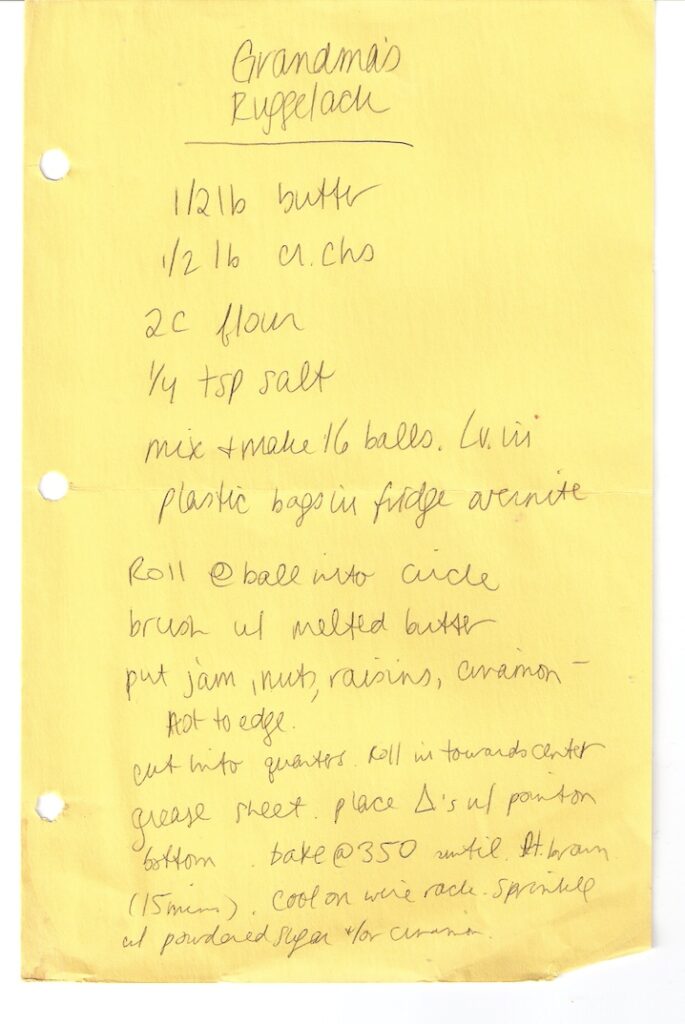
An interpretation of Grandma Anne’s recipe by my mom’s Aunt Bonnie.
Bibliography
Guttman, Vered. “The Little Pastry That Could: How Rugelach Became Israel’s Go to Sweet.”
Haaretz.com. Haaretz, October 8, 2014.
Proust, Marcel, and C. K. Scott-Moncrieff. Remembrance of Things Past. UK: Penguin Classics,
an imprint of Penguin Books, 2016.
Alexa Stevens is an Oberlin College fourth-year student who loves food — especially breakfast food — and journalism — especially when it’s about food. Alexa’s non-food writing has been featured in Teen Vogue, Kidzworld, The Oberlin Review, The Easy Reader, and more.
